

Ask ten gold investors which gold etf is better and you will hear ten different confident answers — yet every fund named holds the same metal. Which gold etf is better is never really a question about gold, then. It is a question about the wrapper: what it charges, how cleanly it trades, and how well it fits the job you hire it to do.
This guide gives you a head-to-head method for any two gold ETFs, using six well-known US funds as the worked example. It is general information, not financial advice, and nothing here is a recommendation. Our other comparisons sit on the GoldZeus homepage.
Which Gold ETF Is Better Starts With the Expense Ratio
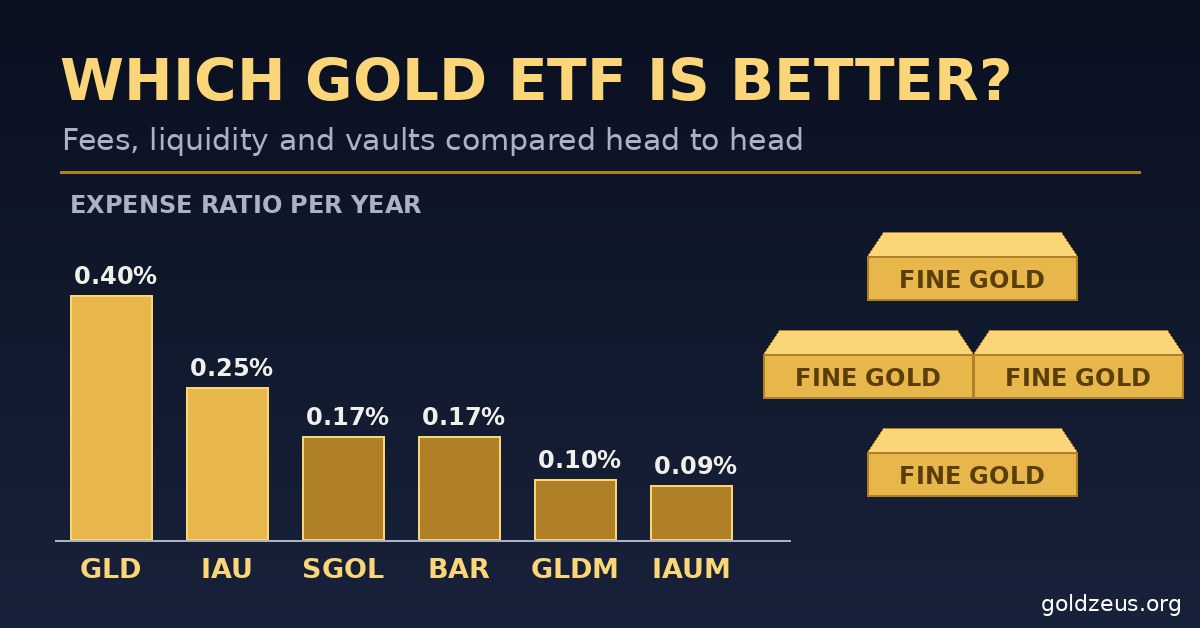
The expense ratio is the one figure you can know in advance. It is paid by selling tiny amounts of the fund’s gold, so pricier funds hold less metal per share over time. The current field:
- GLD (SPDR Gold Shares) — 0.40% a year; oldest and largest.
- IAU (iShares Gold Trust) — 0.25% a year.
- SGOL (abrdn Physical Gold Shares) — 0.17% a year.
- BAR (GraniteShares Gold Trust) — 0.1749% a year, roughly 0.17%.
- GLDM (SPDR Gold MiniShares) — 0.10% a year.
- IAUM (iShares Gold Trust Micro) — 0.09% a year; lowest fee here.
On $10,000 that is about $40 a year in GLD against roughly $9 in IAUM — a $31 gap, growing to several hundred dollars over twenty years. For a buy-and-hold investor, which gold etf is better usually comes down to which charges least. Fees change, so confirm the figure before buying.
Size, Liquidity and Spreads: The Other Half of Which Gold ETF Is Better
Fees are only half the story, because you also pay to trade. GLD holds well over $100 billion, runs the deepest options market of any gold fund, with penny-wide spreads. IAU, at roughly $60 billion, is close behind; GLDM is large enough that most investors never notice a spread. SGOL, BAR and IAUM trade fine at ordinary sizes, but spreads can widen to a few cents, and a rushed market order can cost more than a year of fees. Rule of thumb: the more you trade, the more size matters; the longer you hold, the less.
Structure and Vaulting: What Actually Backs Your Shares
All six are grantor trusts holding allocated physical bars — not futures contracts or mining shares. Each publishes a bar list, audited independently. GLD’s sits mainly in London; IAU’s spreads across London, New York and Toronto; SGOL is the pick people name when they want Zurich vaulting too.
The structure check is simple: physically backed, allocated, audited. A fund that cannot say where its gold is and who counts it earns a mark against it when weighing which gold etf is better. The World Gold Council publishes useful background on vaulting standards.
Tracking Difference: The Gap Between a Fund and the Gold Price
A gold ETF should follow the gold price minus its fee — no more, no less. Tracking difference measures that gap: compare fund and spot-gold returns over one and five years. A fund charging 0.25% that trails gold by about 0.25% a year is doing its job, because the fee explains the gap. A fund trailing by noticeably more hints at friction inside the trust.
Checking it takes two minutes on the sponsor’s site, and it is one of the most honest tests of which gold etf is better in practice — it measures what investors actually kept.
Share Price and Day-to-Day Handling
GLD changes hands in the mid-$300s, IAU in the low $70s, GLDM in the high $70s, and IAUM, SGOL and BAR in the high $30s. With fractional shares this hardly matters; without them, a low share price makes small monthly purchases far easier to size.
Two more notes: none of these funds pays a dividend, because vaulted gold earns nothing, and the trust sends annual tax information rather than a dividend statement.
The Tax Check US Investors Should Not Skip
Because these trusts hold physical metal, US tax law treats them as collectibles. In a taxable account, long-term gains can be taxed at up to 28% federally — above the 20% maximum on most stocks — and short-term gains at ordinary income rates.
The rule hits every physically backed fund equally, so it separates no fund from another. It does shape the wider comparison, and it is one reason many holders use a retirement account, where the collectibles rate does not apply year by year. Rules and situations differ, so check your own position; this is not tax advice.
Putting It Together: Match the Fund to the Job
So, which gold etf is better? Run the head-to-head in order — fee, liquidity, structure, tracking, handling, tax — and the answer usually falls out. A holder measuring in decades is mostly buying the fee — basis points saved compound. A trader moving around news, or using options, is mostly buying liquidity, and may happily pay GLD’s higher fee for it.
Our companion guide asks which gold etf is best outright; together, the two pages leave you able to defend your choice in one sentence.
Frequently Asked Questions
Which gold etf is better for someone holding for decades?
For a very long hold, the expense ratio dominates: it repeats every year. So the answer to which gold etf is better for a decades-long holder usually points to the lowest-fee funds, spreads permitting.
Is the cheapest gold ETF always the better one?
No. A fund saving 0.15% a year can hand some back in wider spreads if you trade often or in size. Cheap wins for patient holders; traders may value liquidity more.
GLD or IAU — how do I choose between the two giants?
IAU charges 0.25% against GLD’s 0.40%; GLD counters with the larger fund, heavier volume and deepest options market. Holders weigh the fee; traders, the liquidity.
Does it matter where a gold ETF stores its gold?
All six use professional, audited vaults, so storage is sound throughout. Location is mostly preference, not a safety gap between major funds.
How are gold ETFs taxed in the United States?
Physically backed gold ETFs are taxed as collectibles federally: long-term gains can face a maximum 28% rate, short-term gains ordinary income rates. Retirement-account holdings follow the account’s own rules.
Do gold ETFs pay dividends?
No. Vaulted gold produces no income, so there is nothing to distribute. Your return is the gold price’s movement, minus the expense ratio over your holding period.
Conclusion
Which gold etf is better has no single answer, and that is the honest answer. The funds hold the same metal; they differ in charges, market depth, vault location and tracking. Compare any two on those points and the stronger choice becomes clear.
Holding for decades? Bias toward the lowest fee with clean trading. Trading actively? Bias toward size and liquidity, and treat the fee as the price of a deep market. Either way, you pick the wrapper that fits the job, not a ticker on habit.
