

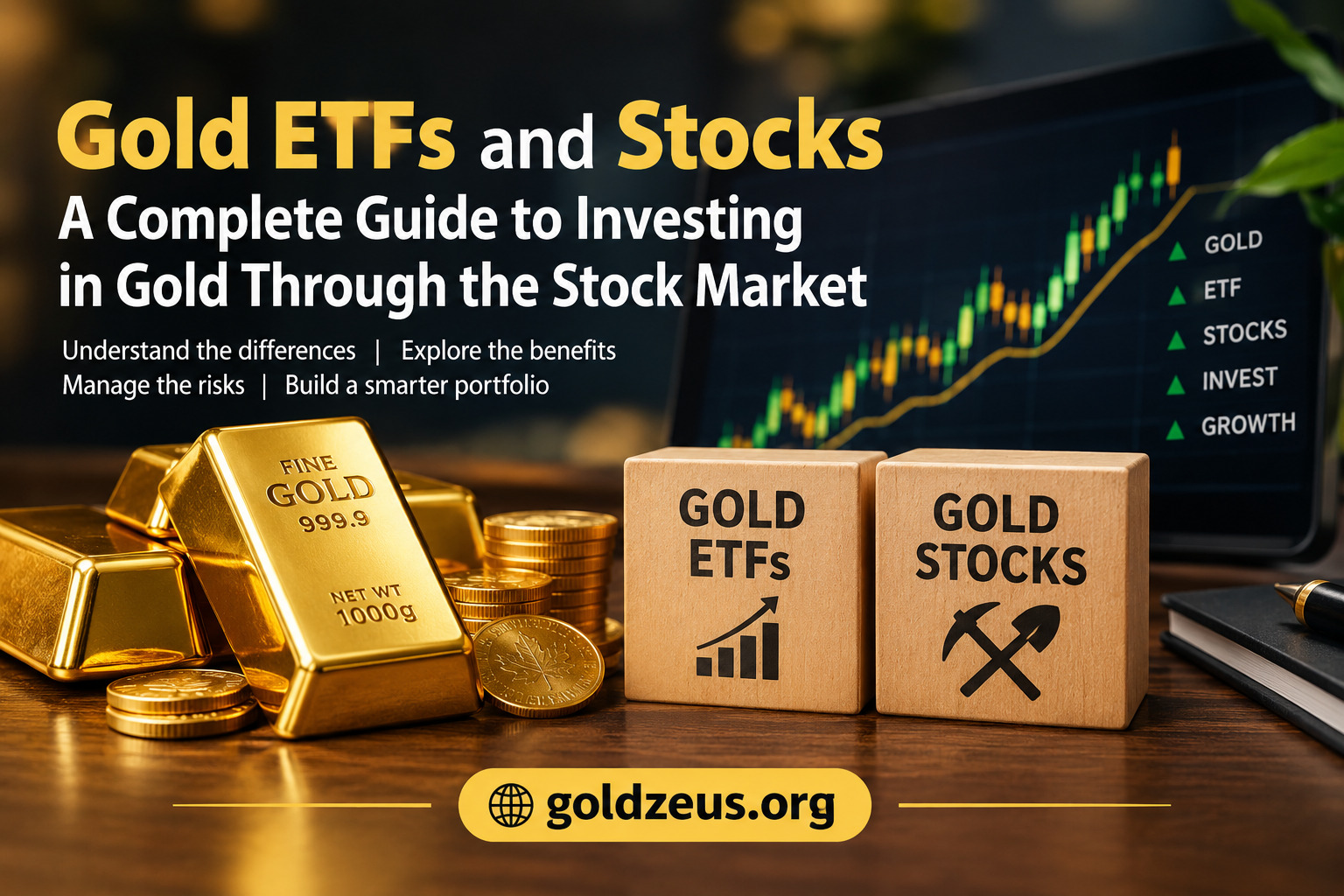
Gold has been used as a store of value for centuries, but modern investors have more ways to gain exposure to the precious metal than simply buying physical gold. Two popular options are gold ETFs and stocks, which allow investors to participate in the gold market through traditional brokerage accounts.
Gold exchange-traded funds (ETFs) can provide exposure to gold prices without requiring investors to store physical bullion, while gold stocks represent ownership in companies involved in gold exploration, mining, and production. Although both can benefit from a strong gold market, they have different characteristics, risks, and potential returns.
What Are Gold ETFs?
A gold ETF is an exchange-traded fund designed to provide investors with exposure to the price of gold or to companies associated with the gold industry. Gold ETFs trade on stock exchanges, meaning investors can buy and sell shares during regular market hours, much like individual stocks.
Some gold ETFs are backed by physical gold held in secure vaults. Others invest in gold-mining companies or use financial instruments to track gold prices.One of the main attractions of gold ETFs is convenience. Investors do not need to purchase, transport, insure, or physically store gold bars or coins.
How Gold ETFs Work
The structure of a gold ETF depends on the particular fund. A physically backed ETF generally holds gold bullion and issues shares representing an interest in the fund’s assets. The value of the ETF typically moves in relation to the market price of gold, although fees and other factors can cause performance to differ slightly.
Gold-mining ETFs work differently. Instead of holding physical gold, they may hold shares of several companies involved in gold mining. This provides broader exposure to the gold-mining industry rather than directly tracking the price of bullion.
What Are Gold Stocks?
Gold stocks are shares of publicly traded companies that operate in the gold industry. These businesses may explore for gold, develop mines, extract ore, process gold, or provide services to mining companies.
When investors purchase shares of a gold-mining company, they are buying an ownership interest in that business. The company’s financial performance can therefore have a significant impact on the investment.
Gold stocks can sometimes rise more quickly than the price of gold when gold prices increase. This is partly because mining companies have operating costs that may not increase at the same rate as their revenue.
For example, if the price of gold increases while a mining company’s production costs remain relatively stable, its profit margin may expand. However, the opposite can also happen when gold prices decline or operating costs increase.
Why Investors Consider Gold ETFs and Stocks
Gold is often viewed as a potential portfolio diversifier because its performance can differ from that of stocks and bonds during certain market conditions. Investors may consider gold-related investments for several reasons.
Portfolio Diversification
Holding assets with different risk and return characteristics can help diversify an investment portfolio. Gold may behave differently from traditional equities, although diversification does not guarantee protection against losses.Gold ETFs can provide an easy way to add gold exposure without directly purchasing bullion.
Inflation Concerns
Gold is often discussed as a potential store of value during periods of rising prices. Historically, investors have sometimes turned to precious metals when they are concerned about the purchasing power of currencies.gold does not automatically rise whenever inflation increases. Its performance can also be influenced by interest rates, currency movements, investor demand, and economic conditions.
Exposure to Gold-Mining Growth
Gold stocks offer another potential way to participate in the gold market. Mining companies can benefit from higher gold prices if their production costs and other expenses remain under control.This creates the possibility of greater gains than the underlying gold price, but it also introduces additional risks.
Advantages of Gold ETFs
Gold ETFs have several features that make them attractive to investors.
Easy to Buy and Sell
Because ETFs trade on stock exchanges, investors can generally purchase or sell shares through a standard brokerage account.
No Physical Storage
Investors in physically backed gold ETFs do not need to keep gold coins or bars at home or arrange their own storage solutions.
Potential Diversification
Depending on the ETF, a single investment may provide exposure to physical gold or a basket of gold-related securities.
Transparent Pricing
Exchange-traded funds generally have market prices that can be monitored throughout the trading day, making it relatively easy to track an investment’s value.
Risks of Gold ETFs
Gold ETFs are not risk-free investments.The price of a gold ETF can decline when the price of gold falls. ETFs also charge expenses, which can reduce long-term returns. Some funds may use derivatives or other structures that introduce additional risks.
Gold-mining ETFs have another layer of risk because the underlying companies can be affected by labor costs, energy prices, regulations, management decisions, geopolitical events, and operational problems.Investors should therefore understand exactly what an ETF owns before purchasing it.
Advantages of Gold Stocks
Gold stocks can offer greater exposure to the business side of the gold industry.
Potential for Higher Returns
Mining companies can potentially experience significant changes in profitability when gold prices move. If gold prices rise while production expenses remain controlled, earnings may increase substantially.
Dividend Potential
Some established gold-mining companies distribute part of their profits to shareholders through dividends. However, dividends are not guaranteed and can be reduced or eliminated.
Business Growth
Unlike physical gold, a mining company can potentially increase production, discover new deposits, improve efficiency, acquire other businesses, or expand operations.These factors can create opportunities that are not directly available from owning bullion.
Risks of Gold Stocks
The potential for higher returns comes with additional risks.A gold-mining company may face problems that have little to do with the price of gold. Examples include mine accidents, rising fuel and labor costs, environmental regulations, political instability, financing difficulties, or disappointing exploration results.
There is also management risk. Poor capital allocation or unsuccessful expansion projects can negatively affect shareholders.Because of these factors, gold stocks may be considerably more volatile than investments designed to closely track the price of gold.
What Makes Gold Prices Move?
Understanding gold prices is important when evaluating both gold ETFs and stocks.
Several factors can influence the price of gold, including:
- Interest rates
- Inflation expectations
- Currency movements
- Central bank activity
- Global economic conditions
- Investor demand
- Geopolitical uncertainty
- Supply and demand in the gold market
Gold does not generate income in the same way as a bond or a dividend-paying stock. Its investment appeal is therefore closely connected to changes in its market value and its role within a broader portfolio.
How to Choose Between Gold ETFs and Stocks
There is no single option that is suitable for every investor. The choice depends on investment objectives, risk tolerance, time horizon, and desired exposure to the gold market.
An investor primarily interested in following gold prices may research physically backed gold ETFs. Someone seeking exposure to mining companies may instead consider individual gold stocks or diversified gold-mining ETFs.
Before investing, it is useful to examine:
- Investment objective – Determine why you want gold exposure.
- Risk tolerance – Consider how comfortable you are with price volatility.
- Fund expenses – Review the ETF’s expense ratio and other costs.
- Company fundamentals – For gold stocks, examine production, costs, debt, cash flow, and management.
- Diversification – Avoid allowing one investment or sector to dominate the portfolio.
- Investment timeframe – Consider whether the investment fits your short- or long-term goals.
Gold ETFs and Stocks in a Diversified Portfolio
Gold-related investments can potentially play different roles within a portfolio.A physically backed gold ETF may provide relatively direct exposure to movements in gold prices. Gold stocks may provide exposure to the profitability and growth prospects of mining businesses.
Some investors may use one type of investment, while others may consider several forms of gold exposure. The important point is to understand that these investments are not interchangeable.A gold ETF focused on bullion and a gold-mining stock can react differently to the same market event. Investors should evaluate each security based on what it actually owns and the risks associated with it.
Gold ETFs and Stocks: Long-Term Considerations
Investing in gold-related securities requires more than simply watching the daily gold price. Long-term investors should consider fees, volatility, economic conditions, company fundamentals, and portfolio allocation.
For gold stocks, profitability is especially important. A company producing gold at a high cost may struggle even when gold prices are strong. Conversely, an efficient producer with healthy finances may have greater flexibility during difficult market conditions.
For ETFs, investors should review the fund’s structure, holdings, expenses, tracking performance, and investment objective.Regular portfolio reviews can also help investors determine whether their gold exposure remains consistent with their overall financial strategy.
Frequently Asked Questions
Are gold ETFs safer than gold stocks?
Gold ETFs and gold stocks have different risk profiles. A physically backed gold ETF generally provides more direct exposure to gold prices, while an individual mining stock is exposed to both gold prices and company-specific risks. Neither investment is completely risk-free.
Do gold stocks always rise when gold prices rise?
No. Gold stocks can benefit from higher gold prices, but their share prices are also affected by production costs, management decisions, debt, operational performance, market sentiment, and other factors.
Do gold ETFs pay dividends?
It depends on the type and structure of the ETF. A physically backed gold ETF generally does not operate like a dividend-paying company, while ETFs that hold mining companies may have different income characteristics.
Can gold ETFs be held for the long term?
Some investors use gold ETFs as part of a long-term diversified portfolio. However, suitability depends on an individual’s objectives, risk tolerance, and overall investment strategy.
Are gold stocks more volatile than gold ETFs?
Individual gold stocks can be more volatile because they are affected by both the gold market and company-specific events. A diversified gold ETF may reduce some individual-company risk, although it can still experience significant price fluctuations.
Should investors choose gold ETFs or gold stocks?
The answer depends on what type of gold exposure an investor wants. Gold ETFs can offer convenient exposure to gold or a group of gold-related assets, while gold stocks provide ownership in individual mining businesses. Investors should compare their objectives, risks, costs, and time horizon before making a decision.
Conclusion
Gold ETFs and stocks provide investors with different ways to participate in the gold market without necessarily purchasing and storing physical bullion. Gold ETFs can offer convenient exposure to gold prices or a diversified group of gold-related companies, while gold stocks provide direct ownership in businesses involved in gold production and exploration.
The key difference is the source of investment performance. A bullion-focused ETF is primarily influenced by gold prices, whereas a mining company’s performance can depend on gold prices, production costs, operational efficiency, management, debt, and broader business conditions.
