

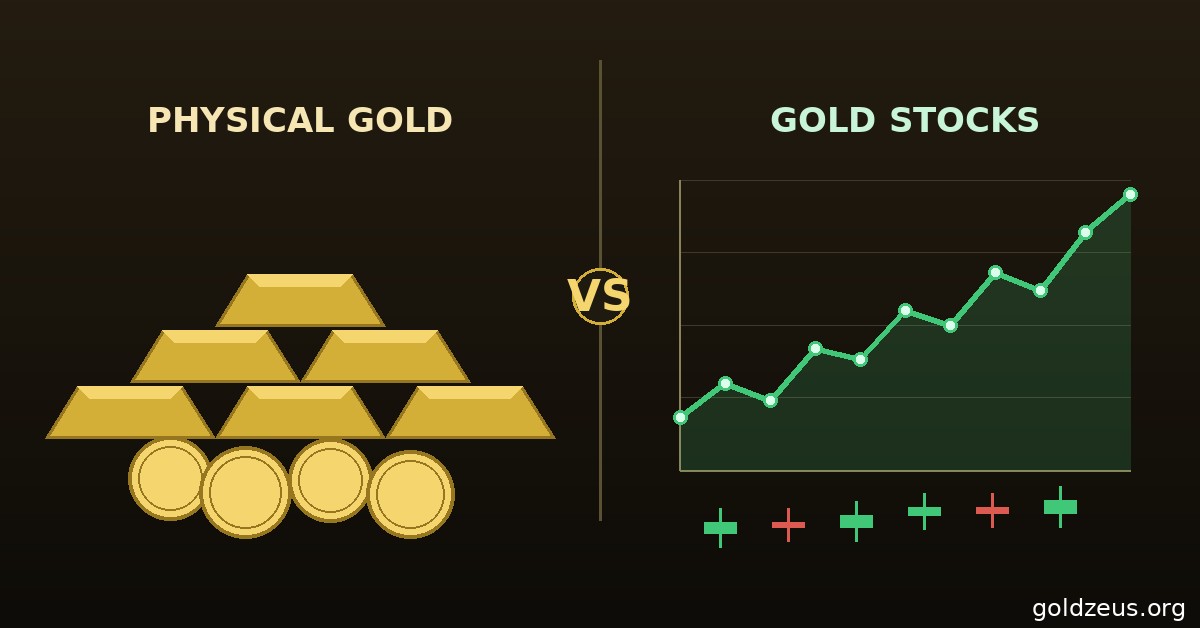
Is it better to buy physical gold or gold stocks? It is the first question people ask when gold makes headlines — and with spot gold around $3,900 an ounce at the end of October 2026, down from a record near $5,500 in January, plenty are asking it now. In truth, the two are not the same investment in different clothes. One is the metal itself. The other is a business that digs it out of the ground.
There is no single winner, and anyone who says otherwise is selling something. Instead of a verdict, here are the real costs and risks behind the is it better to buy physical gold or gold stocks question.
Is It Better to Buy Physical Gold or Gold Stocks? What You Actually Own
Buy physical gold and you own the thing itself: a coin or bar, in your safe or a vault. If every exchange closed tomorrow, your gold would still be gold — that is what no counterparty risk means. Nobody has to stay solvent for it to exist.
Buy gold stocks and you own shares in mining companies — businesses with mines, debts and managers. Some are giant producers; others are small explorers. There is also a middle option: ETFs backed by physical metal, with no storage hassle. Our guide to the best gold stocks to buy covers that side of the market.
The Costs: Premiums and Storage vs Fees and Expense Ratios
Physical gold costs more than the headline price. Dealer checks in October 2026 put typical premiums at roughly 3% to 6% over spot for one-ounce coins and bars — large bars closer to 1% to 3%, tiny bars far higher. Keeping it safe costs too: allocated vault storage with insurance runs about 0.1% to 1% of value per year, while home storage needs a serious safe and extra insurance — standard policies cap bullion cover low.
Gold stocks and gold ETFs are cheaper to run: many brokers charge little or no commission, and big physically backed ETFs charge about 0.10% to 0.40% a year. Mining shares carry no annual fee, but the bill can arrive as extra risk instead.
How Each One Behaves When the Gold Price Moves
Physical gold moves one-for-one with the metal: steady and uneventful. Gold stocks are different, because a miner’s costs are largely fixed. A rising gold price can expand its profit margin far faster than the price itself, and miners have historically moved roughly two to three times the gold price, both ways. That leverage cuts hard on the way down, and miners often fall with the stock market too.
Then there is company risk. A mine can flood, a government can raise royalties, a deal can go wrong. None of that can happen to a bar in a vault. The World Gold Council publishes research on gold’s behaviour alongside equities.
Selling Up: Liquidity and Spreads
Shares win on convenience: you can sell gold stocks or an ETF in seconds during market hours. Physical gold takes more effort: you sell back to a dealer, usually at or slightly below spot, so you rarely recover the buy-in premium in full. That round-trip spread is the quiet cost — one reason coins suit people who hold for years, not months.
Dividends, Income and Tax
A gold bar pays you nothing while you own it. Some established mining companies do pay dividends, yielding roughly half a percent to a few percent in good years, which matters if you want income too. Physically backed ETFs pay no dividends either.
Tax varies by country too: in the US, for example, physical gold is taxed as a collectible, shares as ordinary equities. Check your own rules first.
So, Is It Better to Buy Physical Gold or Gold Stocks for You?
Physical gold tends to suit people who want control, privacy and long-term insurance: something tangible that depends on no company or stock market, held for a decade or more. Gold stocks tend to suit people who want growth potential and possible income, accept bigger price swings, and are happy in a normal brokerage account. The GoldZeus homepage guides cover each route in more depth.
Is It Better to Buy Physical Gold or Gold Stocks — or a Mix of Both?
Many experienced investors skip the is it better to buy physical gold or gold stocks debate entirely and hold some of each: physical metal as the sleep-well foundation, plus mining shares or a gold ETF for extra growth. A mix spreads the weaknesses — the metal’s lack of income against the shares’ extra risk. One important note: this article is general information, not financial advice. Your circumstances are your own, and a regulated adviser can see your full picture as no website can.
Frequently Asked Questions
Is it better to buy physical gold or gold stocks for beginners?
Neither is automatically better. Beginners often start small — one one-ounce coin, or a low-cost gold ETF in a brokerage account — and add later. Ask yourself: does storing metal worry you more, or watching share prices swing?
Do gold stocks pay dividends?
Some do. Established miners pay when profits allow; royalty firms are steadier, though amounts vary and can be cut. Bars and physically backed ETFs pay nothing.
How much over the spot price should I expect to pay for physical gold?
In late 2026, one-ounce coins and bars carried premiums of roughly 3% to 6% over spot; larger bars cost less per ounce, small bars much more. It is a practical part of the is it better to buy physical gold or gold stocks comparison — shares have no such cost.
Are gold stocks riskier than physical gold?
Generally, yes. Mining shares add operating leverage, company decisions and country risk, and their worst falls have been far deeper than the metal’s. Gold itself still falls, as it did sharply in 2026, but no company can go bust underneath it.
Can I hold physical gold in a retirement account?
In some countries, yes, via specialist self-directed arrangements with approved custodians, usually for extra fees. Check your country’s rules first.
What is the cheapest way to get exposure to gold?
A low-cost physically backed ETF at around 0.10% a year, with no dealer premium, is hard to beat on fees. But whichever side of is it better to buy physical gold or gold stocks you choose, cheapest is not always best — taxes matter too.
Conclusion
So, is it better to buy physical gold or gold stocks? Physical gold offers direct ownership with no counterparty risk, at the cost of premiums, storage and zero income. Gold stocks offer convenience, possible dividends and leveraged upside, at the cost of bigger swings and company risk. Neither answer is wrong — they are different tools for different jobs.
Decide what job you want gold to do first — insurance, growth, income, or a blend — and the right vehicle becomes obvious. Start small if unsure, keep costs low, and remember: the best holding is one you can hold calmly when prices fall.
