
If you are asking which gold etf is better 2026, you are not asking which fund holds the best gold — they all hold the same metal. The real question is which wrapper costs least, trades cleanest, and fits how you invest — especially after a wild year for gold.
The honest answer is that which gold etf is better 2026 depends on how long you hold, how often you trade, and how much you invest. Below is the shortlist and how to match a fund to your style. Our GoldZeus home page gathers our other gold guides.
Which Gold ETF Is Better 2026: The Shortlist at a Glance
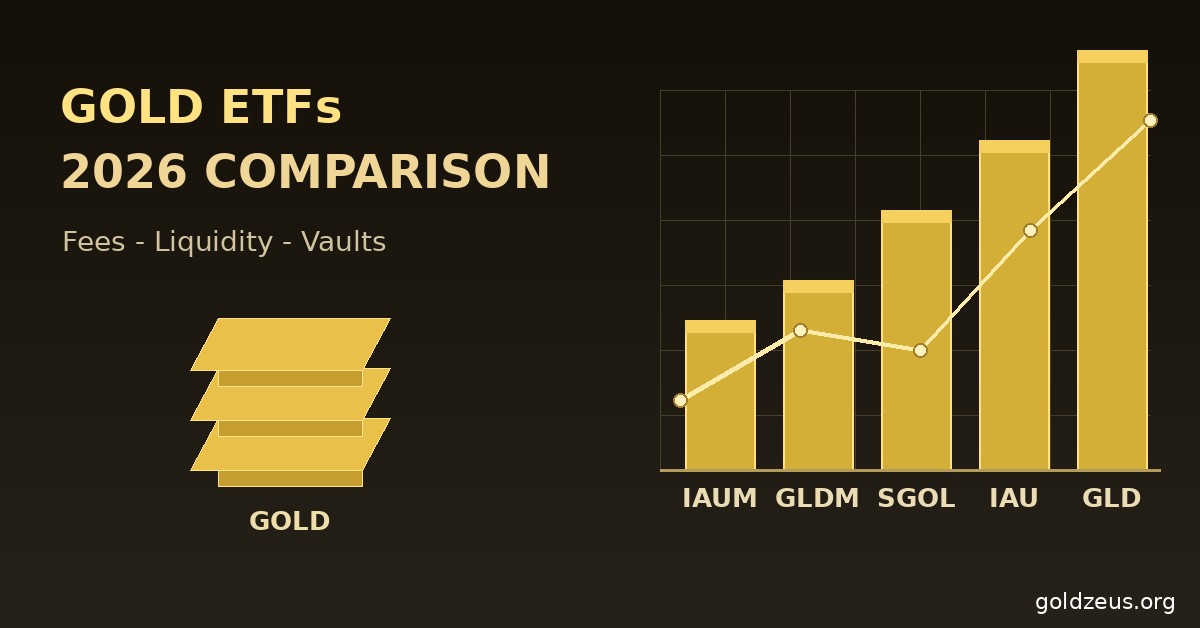
Six funds dominate the US market for physical gold. Each holds allocated bars in a vault and tracks the spot price, minus its fee. When readers ask which gold etf is better 2026, these names come up every time:
- GLD (SPDR Gold Shares) — the oldest and largest, at 0.40% a year.
- IAU (iShares Gold Trust) — the second largest, at 0.25% a year.
- GLDM (SPDR Gold MiniShares) — GLD’s low-cost sister fund, at 0.10% a year.
- IAUM (iShares Gold Trust Micro) — the cheapest at 0.09% a year, with a low share price.
- SGOL (abrdn Physical Gold Shares) — 0.17% a year; gold vaulted in Zurich and London.
- BAR (GraniteShares Gold Trust) — about 0.17% a year; a smaller fund.
There is no bad fund on that list. The differences are in the details, and they compound over time.
Fees First: What the Expense Ratio Really Costs You
The expense ratio is the one number you can know in advance, so it deserves the closest look when you weigh which gold etf is better 2026 for a long hold. It leaves the fund yearly, so pricier funds slowly hold less gold per share.
On $10,000, GLD at 0.40% costs about $40 a year; IAUM at 0.09% about $9, and GLDM at 0.10% about $10 — roughly $30 saved yearly on the same gold, and several hundred over a decade. But fees are not everything: a fund traded often can cost more in spreads than it saves in charges.
Size, Liquidity and Spreads: Why Traders Still Pick GLD
GLD is the giant, holding well over $100 billion at points in 2026, with by far the deepest options market. IAU sits second, in the tens of billions; GLDM is large too. The rest are smaller, but still easy to trade.
Size matters when you judge which gold etf is better 2026, because busy funds quote tighter bid-ask spreads — the gap between buy and sell prices. A weekly trader can lose more to wide spreads than to a higher fee, so GLD stays the default for short-term trades. For a yearly buyer, spreads are pennies and the fee wins.
Where the Gold Sits and What One Share Buys You
Most of these trusts keep their bars in London, the centre of the bullion market. SGOL is the exception: much of its gold sits in Zurich, Switzerland, which some savers prefer for geographic diversification. Custody details and bar lists are published on the official SPDR Gold Shares site and each sponsor’s fund page.
Share price is the other quiet difference. GLD trades at several hundred dollars a share — roughly a tenth of an ounce. IAUM and BAR trade in the tens of dollars, GLDM and IAU in between. Returns are unaffected, but a lower price helps monthly investors buy full shares instead of leaving cash idle.
Gold Miners Are a Different Animal: GDX and GDXJ
Every debate about which gold etf is better 2026 runs into two tickers from a different basket: GDX and GDXJ. They hold no gold. GDX, the VanEck Gold Miners ETF, holds large miners at 0.51% a year; GDXJ holds smaller miners at 0.52%.
Miners can rise faster than gold, because profits are leveraged to the metal. They can also fall while gold rises — on fuel costs, labour disputes, political trouble, or stock-market panic. They are stocks, not gold.
Which Gold ETF Is Better 2026 for Your Type of Investing?
So, which gold etf is better 2026 once you match the fund to the person? Here is the honest split:
- Lowest-cost long-term holder: IAUM at 0.09% or GLDM at 0.10% — the fee saving compounds for years.
- Active trader: GLD, or IAU as a cheaper second choice — depth, volume and options beat the fee.
- Small monthly investor: IAUM or BAR — low share prices keep small sums fully invested.
- Vault-conscious saver: SGOL — for gold stored in Switzerland as well as London.
Our guide to the best gold ETF compares these funds further. Treat everything here as general information, not financial advice — your tax position, account type and goals can change which fund suits you.
The 2026 Backdrop: Why This Choice Matters Now
Gold set a record above $5,500 an ounce in January 2026, helped by years of central bank buying — roughly 1,000 tonnes a year recently. By late October 2026 it had pulled back below $4,000, for the first time since July, as firmer inflation data lifted expectations of further US rate rises.
That swing is why which gold etf is better 2026 deserves a calm answer. When prices whipsaw, the costs you control — fees, spreads, sensible sizing — matter more, not less. A cheap, liquid fund cannot shield you from falls, but it stops you overpaying for exposure.
Frequently Asked Questions
Which gold ETF has the lowest fees in 2026?
IAUM, at 0.09% a year, with GLDM close behind at 0.10%. Check the sponsor’s page before buying, as fees can change.
Is GLD still worth it at 0.40%?
For frequent traders, often yes — depth, tight spreads and options can outweigh the fee. Long-term holders usually do better in a cheaper fund.
Do these gold ETFs really own physical gold?
Yes. All six are trusts backed by allocated bullion in vaults. Some other products use futures, so check the structure first.
Are GDX and GDXJ gold ETFs?
Not in the bullion sense. They hold mining stocks, at 0.51% and 0.52%, and are usually more volatile than physical funds.
How much gold should a beginner hold?
There is no universal figure, and this article cannot advise you personally. Many diversified investors keep gold as a small supporting holding. Take regulated advice if unsure.
Can I hold these ETFs in a retirement account?
Generally yes, in brokerage retirement accounts. Tax treatment in taxable accounts can be complex, so check your account rules.
Conclusion
There is no single winner for every saver. For most long-term holders, the cheapest well-run funds — IAUM and GLDM — are a strong default; for traders, GLD’s depth still earns its fee. Match the fund to how you invest, and the choice gets simpler.
Whichever you choose, check the live fee and spread on the day you buy, and size your position sensibly. The fund is only the wrapper — the gold inside is identical. What you keep after costs is the real difference.
